The End of the Beginning
June 22, 2013 2 Comments
After a long pause in my blog posts over the last few months, the day has arrived. The day that I have anticipated for so many days. The day that I knew would eventually come but somehow imagined might never come. The day that I have longed for, and feared, for decades. The day that this blog has led up to all along: residency graduation. At moments like this, my words begin to sound cliché despite my best efforts: a spectrum of emotions is cast as clouds across my sky, and I find it difficult to sift through and focus on the most poignant of them. And so today I will borrow Margaret Atwood’s eloquent words from “The Moment.”
The moment when, after many years
of hard work and a long voyage
you stand in the centre of your room,
house, half-acre, square mile, island, country,
knowing at last how you got there,
and say, I own this,
is the same moment when the trees unloose
their soft arms from around you,
the birds take back their language,
the cliffs fissure and collapse,
the air moves back from you like a wave
and you can’t breathe.
No, they whisper. You own nothing.
You were a visitor, time after time
climbing the hill, planting the flag, proclaiming.
We never belonged to you.
You never found us.
It was always the other way round.
Today, it becomes easy to say, “I own this.” I achieved this. It is mine. Residency, the hospital, the world. I conquered it. But in reality it is residency itself, that metaphorical beast I struggled with for so long, that is releasing me from her firm grasp. Letting me go out into the world, setting me free.

Share this:

The pains of Monday, the gray of growing
April 24, 2012 4 Comments
In the emergency room, Monday is the worst. There’s no way around it. People hold off coming in during the weekend; they hope their symptoms will get better, figure they can hold off just a little longer. And this sentiment begets the Monday afternoon flood of patients – inevitable, painful, never ending. There are some days when things are simply off – today was one of those. My rhythm was broken – in part by an extra person in my critical care area, in part by the patient volume. And so I limped along, feeling as though I was missing something on every patient. There are days like this, I have come to realize. There are days when I find my rhythm easily, get in the groove of things, and then there are days when this breaks down and frustration builds. Unhappy patients who have been waiting hours to be seen does not help the situation. It breeds a highly tense environment, where I feel that I need to first calm people down, then need to care for them properly, and – lastly – to calm myself down. Easier said than done.
The light at the end of the tunnel is here, though. Tomorrow will be my last shift in the emergency department as a third year resident. Hard to believe, really. Only seven more months to go in the coming year, and I will be an attending physician. My blog post on On winter solstice, or becoming real is ever present in my mind and my heart. This is really it. I am savoring every moment left I have with an attending shepherding me, offering his or her insight. And at the same time, I feel as though I am ready – more than ever – to fly. For my patients, I have a strong, growing desire to execute my own plans rather than those of my supervisor. I am ready to be their doctor.

Hues of Gray, Marsha Heiken
I used to believe that residency was a mountain I needed to climb, and that as soon as I reached the summit, things would become clear. But residency is just a small part of a much larger journey – an uphill climb – continuing to learn, continuing to improve my skills, continuing to question myself. Becoming a doctor is a lifelong process. It requires constant questioning, self-reflection, and yes – even self doubt. To become a good physician is to continue working and learning, day in, day out, year after year.
Because no patient is ever black and white. Each one is gray, with subtleties to their stories that can trick you, trap you, mislead you. The skill and art lies in finessing your skills in interpreting each and every shade of gray, in considering each subtlety, each shadow of doubt that crosses your mind. It lies in continuing, no matter how many years of experience you have, to harbor that fine element of uncertainty, of imperceptible fear, that keeps you on your toes, that keeps you wondering. We doctors will never have all the answers. Thoroughness, experience, compassion, and most of all humility are the best we can offer our patients.
Share this:

Maybe…
April 9, 2012 3 Comments
To know that even one life has breathed easier because you have lived. This is to have succeeded. -Ralph Waldo Emerson
Easter Sunday, another chaotic shift. I held a woman’s head gently as she vomited into a bucket, while her 80-year-old mother pulled her hair back from her face. I watched a family weep for not one but two losses, a mother and her daughter. The emergency room was packed. And tragedies always seem even sadder on a holiday.
In light of all this, I realize that I have reached a different vantage point this month. First was the climb, which began slowly in year one. Then I began to climb faster, and faster still, covering more and more mileage in year two. Efficiency, skills, technique – these I have developed and polished over the last three years. But now I have reached another, entirely new vantage point – the higher I climb, the more I see as I look out below me. The emergency room lies in a valley, and I watch the ever-changing landscape with vigilance, calm, and still a slight bit of fear – fear out of respect for what I know can happen here. I envision my patients all there in the valley, and surrounding each of them in my mind’s eye are their illnesses, their perils, and the possible paths that we may tread down together over the next few hours.
The metaphor may seem abstract, but it is not. Each patient occupies a distinct territory in my mind – and the physical equipment surrounding each of them pertains to what I perceive their needs to be in the next few hours. The people around each of them are families and friends. And the boundaries separating these patients are minimal – mere curtains between one and the next. These patients and their families, strangers outside these walls – here, in this landscape, they have become neighbors. They hear and view the suffering of one another. They share a common path today.
As the guardian over this landscape, I watch my ever-changing valley over the course of my shift; I watch these patients’ stories unfold. I can smell forest fires and hear distant thunder from miles away, and sometimes I can even predict their exact location and nature before they occur. Other times I am caught off guard, but only for a fraction of a second until I compose myself and begin to react. And although these are my grounds, I too – like my patients – have become part of the landscape.
My patients’ suffering, the pathophysiology of disease, the hope of their families, and the waiting – all of these realities are entwined together in my mind as I watch this landscape unfold before me. It is a breathing, living being. And I am watching it all, but also sculpting it in my very palms – trying to change people’s paths, trying to readjust things to make for a better picture, trying to create health from sickness. Trying to help people live. And I am doing this with the nurses, the technicians, the chaplains, the social workers. We are all doing it together. Creating and recreating a landscape. Trying to paint a more beautiful picture.
We only have a small hand in this, though. We can only offer our intellect, our sweat, our compassion, and our skills. But even this – how much does it really change people’s paths? Less than we might hope.
Even so, I still hope. Maybe my presence, or spirit, or efforts – maybe they will make the difference. Maybe they will be just enough to change one destiny, to paint one or two strokes on this landscape that lies below me, to leave one sculpted mark on this world. Maybe one frail mother will keep her petals a little longer in the wind with my palm shielding her. Maybe the umbrella I cast beneath the clouds will save one small boy who lost his raincoat.
Maybe not. But maybe…. And it is the maybe that makes me keep coming back. It is this maybe that makes me not want to give up, in spite of how difficult and trying this journey has been. It is this maybe that makes me want, more than anything, to be an emergency room doctor.
Share this:

This Too Shall Pass
January 27, 2012 2 Comments
As I begin to round the bend on my last lap – year four of residency – my view of the world has opened. My tunnel vision is beginning to subside. I take in my surroundings – the rooms of my emergency room, the closets, the counters, these cold, hard tiles. This chair and counter, where I have spent countless days and nights, working, racing, learning. Even these will be gone soon. It is the simple things – the distinct sound of the black phone ringing next to me, begging to be heard as I stubbornly ignore it. Room Number 5 where, for the first time, my attending turned to me and said, “You saved someone’s life today.” I see the ghosts of patients in each bed – how many I have cared for. I wonder if they still remember me.
I realized today that residency is not static. The people who have come on this journey with me – we have traveled through residency together, but we have also traveled through life together. Some have balded, others have given birth. All have cried and laughed and struggled. Some have suffered through their own illnesses during this time, or the loss of loved ones. And our attendings – they too have aged. Four years is not an insignificant amount of time in life.
I had hoped that time would freeze during these last four years – and that somehow I could it win back. I deserved it – after all that I have sacrificed. But time – life – does not work this way. These years have passed…and I have let them pass by simply waiting for the end. Looking back, I realize how much has been lost, swept away, missed. Life has happened during these years of tunnel vision, sleepless nights, and overwhelming hardships.
I feel my feet on the pavement – there is a calm that comes with rounding the bend on lap three. Deep breaths, fresh air – I am finding my stride as a physician. My pace is steady now – the finish line is close enough that I can sense it right there, just beyond my reach. My shifts ebb and flow, all with the knowledge that the river has run its course and I am almost there. The ease with which I now do central lines, arterial lines, intubations, lumbar punctures, calms me. There is a peace that comes with lap three. I will take this time I have left to look around, to remember, and to think about all that has happened on this journey.
Share this:

On winter solstice, or becoming real
December 2, 2011 3 Comments
December 2011. X marks the spot. In exactly 18 months, this journey will be complete. But now is the time that I begin to get nervous. Residency is easy, relatively speaking. Easy, you may ask? After these blog posts about grieving, hardship, long hours, and sacrifice? But how?
Ah, my friends, I have painted the picture too grimly. It is only with time that my lens has cleared and reveals…life in the real world. Residency offers us much protection. We have strict hours restrictions. We still go to school, and get paid to do it. We always have an attending to call on for help. We always have the excuse that we are “still in training” when there is something we do not know. We are protected from much of the litigation that floods the world of medicine today.
It is the life of an attending that is difficult. As emergency physicians, we bear the weight of people’s lives on our shoulders – and we do it alone. And, in some sense, we harbor responsibility for each bad outcome that happens on our watch, in our department. And – if we are good – we ask ourselves, again and again, “Was this something I could have prevented, if I had acted quicker, smarter, better?” And we ask, “Was there something I missed?” And we ask, “What if?”
There is a quote from a children’s story that I will cite here…
“What is real?” asked the Rabbit one day.
“Real isn’t how you are made,” said the Skin Horse. “It’s a thing that happens to you.”
“Does it hurt?” asked the Rabbit.
“Sometimes,” said the Skin Horse, for he was always truthful. “When you are Real you don’t mind being hurt.”
“Does it happen all at once, like being wound up,” he asked, “or bit by bit?”
“It doesn’t happen all at once,” said the Skin Horse. “You become. It takes a long time. That’s why it doesn’t happen often to people who break easily, or have sharp edges, or who have to be carefully kept. Generally, by the time you are Real, most of your hair has been loved off, and your eyes drop out and you get loose in your joints and very shabby. But these things don’t matter at all, because once you are Real you can’t be ugly, except to people who don’t understand.”
– Velveteen Rabbit, Margery Williams
Residency is all about the process of becoming real, of walking farther along the path to “doctor-hood” – the path to adulthood. The path to making one’s own decisions and standing by them, come hell or high water. But you realize that this journey to “real” has happened only after it is complete, all finished, in the blink of an eye. Real creeps up on you that way, nice and quietly, and then it is there forever.
But, as I look back, the Skin Horse was right – Real is a process, bit by bit, day by day. Over the years, residency has taken its toll, the wrinkles are there, my hair has been loved off, and the memories of all of my patients – through life, death, and everything in between – are present in me, subconsciously affecting my decisions at each critical turn. And real hurts, too – more than you would imagine. No one ever said it would be easy. It is scary sometimes. Sad sometimes, too.
But it is real, after all.
I still remember when one of the bravest attendings I know told me that she had hoped, in those first few years after residency while driving to her single-coverage overnight shifts at the hospital, that she might get into a minor car accident just so that she could have a reason to call out that night, not go. She is one of the bravest people I know. And even she had a hard time becoming real, in the beginning.
People ask me what I want to be when I grow up, now that I will be graduating in 18 months and interviewing for jobs in less than a year, and I look at them, perplexed. I know what I do not want to be when I grow up – a medical resident. That is for sure. But what do I want to be? Maybe a real doctor, maybe not. Maybe a writer, but that will never pay off my monstrous loans. Maybe a teacher, I have always loved to teach. Or maybe I just want to be me for a while, and be free for a while, not a slave to my occupation.
I always used to have an answer to this question. In high school, I wanted to go to college to be pre-med. In college, I wanted to be pre-med to go to medical school. In medical school, I wanted to go to residency. And somehow, after all these years of a nice, clean and cut path to success, I find my feet faltering at this next step. Part of me is hesitating, does not want to venture on anymore.
The more time passes, the farther I travel, the less I know. But maybe this is all part of the process…I am not real yet, after all.
Share this:

Leonardo da Vinci, Anatomical Studies
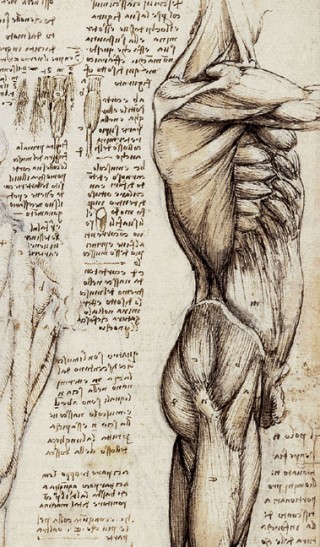
Muscles of the Side of the Torso, c. 1507
 A Medical Resident's Journey